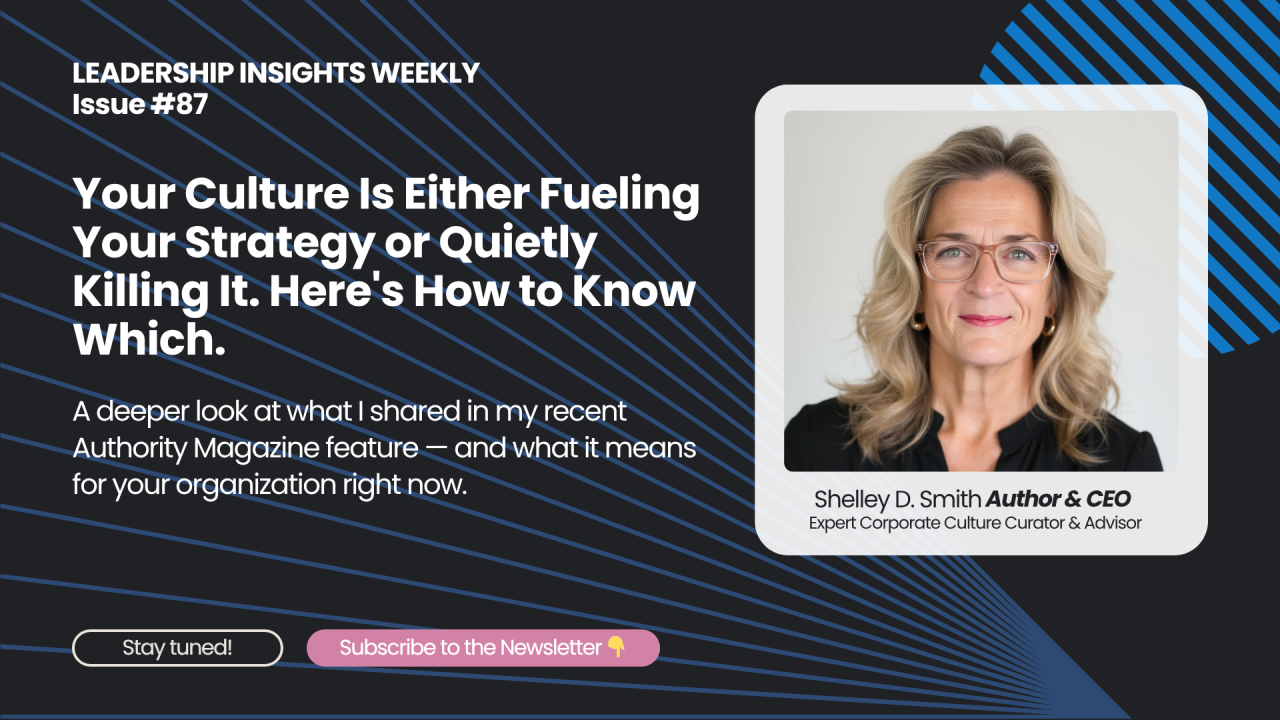

Commitment over compliance separates thriving cultures from failing ones. Learn to detect the signals, build committed teams, and lead change that creates ownership.


I've been asked some version of this question for almost four decades: "Shelley, what does a healthy culture actually look like?"
And every time, I give the same answer that makes people pause.
It's not ping-pong tables. It's not free snacks. It's not even a great benefits package.
It's commitment over compliance.
Let me explain what I mean, and why the difference between those two words is costing some organizations everything.
Last week I was a guest on The Future-Proof Leader podcast with Jessica Rapach, CEO of Twin Legacy Solutions.

Within the first five minutes of our conversation, we landed on something I say often but never get tired of saying:
Every organization has a culture.
The question is whether it's the culture you defined, or the one that just happened to you.
Most leaders will tell you they have a great culture.
They point to the words on the wall. The mission statement in the lobby. The values listed on the website.
But then I walk in.
And within a few minutes, watching how people move through the hallways, how the receptionist greets a visitor, whether people make eye contact or stare at their phones in the elevator.
I already know the real story.
Culture isn't what you say.
It's what you do when no one's watching.
And more importantly, it's what your people do when you're not watching.
That's what I've spent 35 years learning to read: the invisible signals that your engagement survey won't capture for another 9-12 months.
The patterns that show up in how culture leaks before anyone notices.
In my book Thirsty, I talk about droplets.
Every single interaction either hydrates your organizational culture or dehydrates it.
A greeting. A meeting.
A deadline honored or not.
A mistake owned or deflected.
Most leaders don't think about that.
They're watching the dashboard, celebrating green lights, and assuming everything is fine.
Then one day their highest performer resigns and they say, "Wait, why are you leaving?"
The signals were there all along.
A compliant team shows up.
They nod in meetings. They do what they're told. They hit the metrics, barely, and go home.
A committed team? That's a different animal entirely.
Committed people bring ideas you didn't ask for. They push back on what's not working, respectfully but clearly.
They own their mistakes. They stay past five o'clock not because they have to, but because they care.
The organizations that have committed teams are the ones that don't struggle to attract talent, because word gets out.
Their people become their best recruiters. "When you're hiring, I know someone, and you want them here."
That's a culture that's been built, tended, and protected. Not stumbled into.

Here's what I told Jessica, and I'll say it to you directly:
The price of a disengaged culture is not abstract.
It shows up in your turnover rates. Your error rates. Your top-line revenue. Your profitability.
Those are the hard numbers, the ones that show up in board decks.
But the organic cost? That's what I call the Sunday Night Blues.
Your people dreading Monday morning.
Complaining about the hybrid schedule, not because of the commute, but because they don't want to be there.
Meetings about meetings. Action plans that never get executed. Voices that are present but not heard.
Burnout. Anxiety. "We're at capacity."
Would you rather hear that, or would you rather build something where people come to work because they actually want to be there?
One of the things Jessica and I got into was change management, arguably one of the hardest leadership skills to actually get right.
Here's where most leaders get it wrong: they bring the change to their people.
They announce it. They explain the why. They expect buy-in.
But buy-in doesn't come from telling. It comes from asking.
Try this instead: before you announce the change, ask the question that gets your team there themselves.
"If we could cut our error rate in half, what would we do differently?"
Let them arrive at the answer. Let it be their idea.
Because change that's done to people creates resistance.
Change done with people creates ownership.
And ownership? That's where commitment lives.
This is the same principle behind why mastering change execution requires building it into the culture itself, not bolting it on as a program.
Jessica mentioned something that stuck with me.
She talked about how in the Marine Corps, there is no Plan B. You complete the mission. Period.
I've coached and advised leaders for nearly 40 years, and I can tell you this: the moment you create a backup plan, you've given your brain an exit ramp.
You've already told yourself it's okay to not go all in.
I'm not talking about being reckless. I'm talking about commitment. The real kind.
The kind that bends like a snake when the path shifts, but never stops moving toward the mission.
That's the energy of leaders who build cultures that last.
If any of this is hitting close to home, if you're sensing something's a little off, or you're watching your green lights start to flicker, that's not a coincidence.
That's a signal worth paying attention to.
And in my experience, by the time you're noticing it consciously, the pattern has already been running for months.
The culture has been telling you. The question is whether you've been listening.
Ready to find out what your culture is actually saying?
Book a Discovery Call and let's get to work.
What is the difference between a committed and compliant team?
A compliant team shows up and follows instructions. They nod in meetings and do what they're told. A committed team brings unsolicited ideas, pushes back on what isn't working, owns mistakes openly, and stays engaged because they care, not because they have to. The distinction shows up in retention, innovation, and whether your people recruit others to join.
How do you detect culture problems before they show up in metrics?
Culture signals appear in daily interactions long before dashboards register problems. Watch how people move through hallways, whether they make eye contact, how the receptionist greets visitors, and whether meeting energy is flat or engaged. These leading indicators, what I call "droplets" in Thirsty, reveal the real culture 9-12 months before engagement surveys catch up.
Why do most change management initiatives fail?
Most change initiatives fail because leaders bring the change to their people, announcing it, explaining the why, and expecting buy-in. But buy-in doesn't come from telling. It comes from asking. Change done to people creates resistance. Change done with people creates ownership. Ask your team the question that lets them arrive at the answer themselves.
What is the cost of a disengaged workplace culture?
Disengaged culture shows up in hard numbers: turnover rates, error rates, revenue, and profitability. But the organic cost is what I call the "Sunday Night Blues": employees dreading Monday, meetings about meetings, action plans that never execute, and voices present but not heard. Organizations with committed cultures don't struggle to attract talent because their people become their best recruiters.
How do you build a committed culture instead of a compliant one?
Building commitment requires daily tending, not one-time programs. Every interaction either hydrates or dehydrates your culture. Leaders must read the real signals, involve their people in change rather than announcing it, and commit fully. The organizations that get this right are the ones whose purpose drives the return to work, not policy mandates.
Explore articles, case studies, and resources - crafted to keep you ahead.