
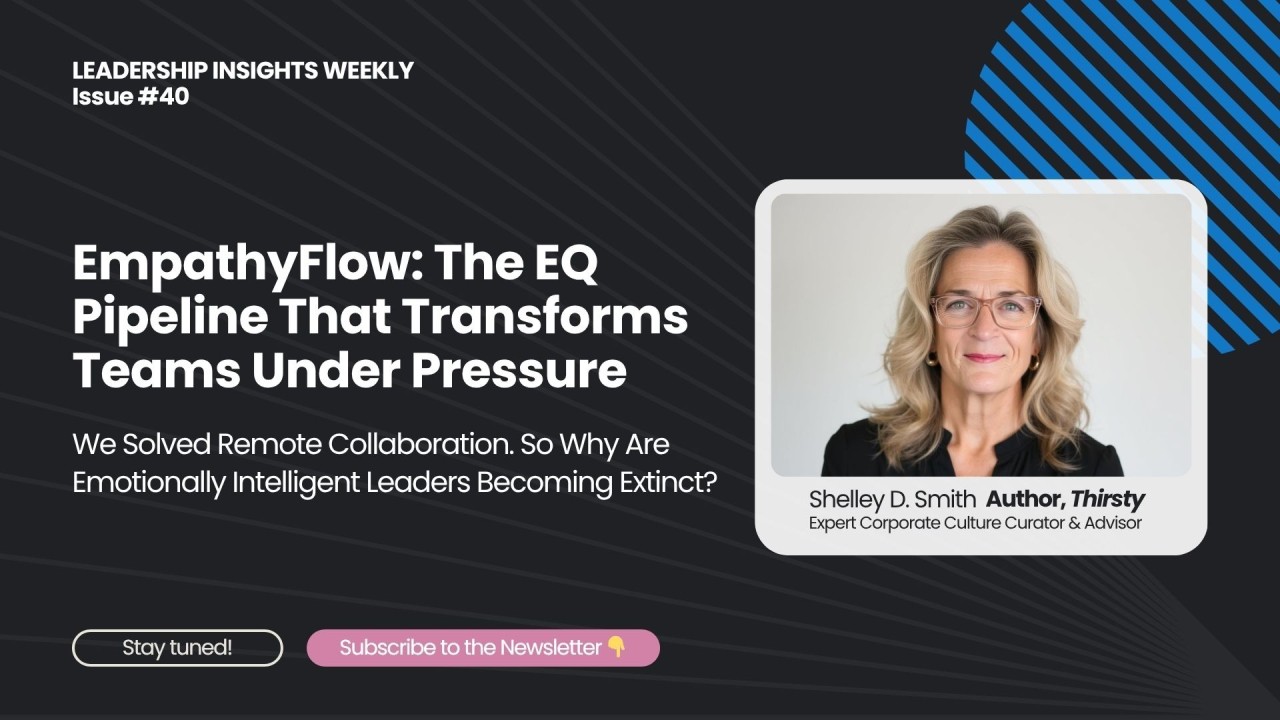
EQ accounts for 58% of job performance, yet most leaders get zero training. Learn the 3 emotional intelligence practices that build resilience when pressure threatens to break your team.

"I know you said I could reach out, but the pressure's getting to me and I don't know how to handle it anymore."
Sarah stares at her screen. VP of Engineering. Fortune 500 company.
Perfect inclusion metrics.
Her star developer is breaking down.
She has no idea how to respond.
Her reply: "Let's sync tomorrow to discuss bandwidth optimization."
Two weeks later? He quit.
She answered the wrong need. He wasn't seeking project management advice.
He was seeking human understanding.
That gap, between technical competence and emotional connection, is bleeding organizations dry.
EQ accounts for 58% of job performance across industries, yet most leaders receive zero formal emotional intelligence training.
The cost of that gap?
Approximately $400,000 per senior executive annually in lost productivity, burnout-driven turnover, and decisions made from reactivity instead of clarity.
Here's what I've observed across decades of working inside organizations.
You can build beautiful trust and belonging systems that work perfectly under normal conditions.
But the moment pressure spikes, a high-stakes client presentation, a restructuring announcement, a budget crisis, everything you've built gets stress-tested in ways no planning session anticipates.
Belonging gets people to contribute.
That's essential. But emotional intelligence is what gets them through challenges together.
I've watched leaders who invested months building psychological safety lose it all in a single high-pressure meeting because they powered through their own visible stress instead of acknowledging it.
The team watched the tight jaw, the rapid-fire speech, the familiar knot everyone could see.
And every belonging signal they'd built started cracking under the weight of unspoken emotion.
The progression matters: inclusion opens the door, belonging invites contribution, and deep emotional connection, "we understand what you're experiencing," builds resilience under pressure.
I saw a CTO do something remarkable during a high-stakes presentation.
Instead of powering through his visible anxiety, the tight jaw, the rushing words, the stress infecting the entire room, he stopped mid-sentence.
"I notice I'm feeling anxious about this timeline, and it's affecting how I'm communicating.
Let me take a breath and reset."
The room held its breath.
Then something shifted. The team relaxed. People shared their own concerns. They found collaborative solutions instead of defensive ones.
That 30-second act of self-awareness did more for team performance than any strategy deck could.
Your micro-practice: Before your next difficult conversation, complete this sentence out loud: "Right now, I'm feeling _____ because _____." Watch how naming the emotion changes the room's energy.
During a major division restructuring, jobs on the line, protocols changing, everything people feared about organizational transformation, a director faced a choice. She could announce the changes clean, efficient, professional.
Instead, she started each conversation with five words: "Help me understand what you're experiencing."
Then she did the revolutionary thing. She listened. Really listened.
Team members poured out fears about job security. Uncertainty about new roles. Concerns about maintaining standards.
Instead of minimizing those feelings, she leaned in.
"That uncertainty makes complete sense. Let me share what we're doing to address exactly those concerns."
The result? Retention through the transition that far exceeded industry averages for restructuring.
Your micro-practice: When someone shares a concern, resist your first instinct to solve it. Instead, respond with "Help me understand what you're experiencing" and count to three before saying anything else.
During the most intense period of one organization's transformation, team stress was spreading like wildfire. One person's anxiety triggering another's, creating cycles of reactivity that threatened everything they'd built.
The solution seemed almost too simple. Emotional circuit breakers.
When team stress hit a breaking point, anyone could call a 15-minute reset.
No judgment. No explanation needed. No questions asked.
Collective pause. Emotional reset. Clear heads.
Your micro-practice: Establish 15-minute emotional resets when pressure builds.
Make it as normal and unremarkable as grabbing coffee.

Small changes in emotional language create massive shifts in connection depth.
Instead of "How's the project going?" try "How are you feeling about where we are?"
Instead of "Let's focus on solutions," try "Help me understand what you're experiencing first."
Instead of "That shouldn't be stressful," try "That sounds challenging. What support would help?"
The difference? One acknowledges the work. The other acknowledges the human doing the work.
Phase 1: Foundation Building (Weeks 1-2). Practice the "Clear Mirror" sentence before every important interaction. Implement daily emotional awareness check-ins. Start naming what you're feeling before you walk into difficult conversations.
Phase 2: Skill Mastery (Months 2-3). Master the "Help me understand" empathy response in difficult conversations. Develop emotional regulation techniques for high-pressure situations. Create team emotional circuit breaker protocols that people will actually use.
Phase 3: System Integration (Months 4-6). Build EQ checkpoints into regular workflows. Train direct reports using the three practices. Measure emotional climate alongside business metrics.
Belonging gets people to contribute their best thinking. Emotional intelligence gets them through challenges together.
The question isn't whether your leaders are "nice" or "empathetic" as personality traits. It's whether your organization has built the systems and practices that enable emotional intelligence to function even when everything is on the line.
Sometimes the most powerful leadership move is admitting you're human first, leader second.
That 11:47 PM message? The right response wasn't about bandwidth or timelines. It was: "That sounds really challenging. How can I support you through this?"
Sometimes retention versus resignation comes down to one emotionally intelligent response.
How many of those moments are your leaders missing?
Yale Center for Emotional Intelligence (organizational engagement and EQ leadership data)
Center for Creative Leadership (cost of low EQ leadership research)
Emotional intelligence determines whether teams hold together or fracture when stakes are highest. Self-aware leaders drive significantly higher team performance and better decision-making under pressure. When pressure mounts, the leader's emotional response either calms or escalates the entire team's stress, making EQ the difference between collaborative problem-solving and defensive reactivity.
Three phases: Foundation Building (weeks 1-2) focuses on self-awareness through naming emotions before difficult conversations. Skill Mastery (months 2-3) develops empathy response techniques and emotional regulation. System Integration (months 4-6) builds EQ checkpoints into workflows and measures emotional climate alongside business metrics. The key is treating EQ as systematic practice, not personality trait.
Low EQ in leadership costs approximately $400,000 per senior executive annually, plus indirect impacts including higher burnout, increased stress-related absences, and lower team productivity. EQ accounts for 58% of job performance across industries, yet most leaders receive zero formal training. Organizations with empathetic leaders achieve 40% higher engagement.
Emotional circuit breakers are brief, team-authorized pauses, typically 15 minutes, that anyone can call when collective stress reaches a breaking point. No judgment, no explanation, no questions asked. These resets prevent the cascade where one person's anxiety triggers another's. The key is normalizing the practice so it becomes as unremarkable as grabbing coffee.
Explore articles, case studies, and resources - crafted to keep you ahead.