
Cultural transformation doesn't require perfection. It requires permission to begin imperfectly. Here's why the leaders who act before they feel ready are the ones who change everything.

This morning, I got a message from a successful consultant who's been following our journey: "Just ordered! Can't wait to learn from the Culture Queen!"
This is what happens when content builds toward action.
The excitement isn't just about getting a book into the world. It's about finally being able to share a powerful roadmap for cultural transformation that people can put to use.
Over these past months, I've watched something fascinating unfold.
Some leaders consumed every piece of content, nodded along with the insights, and said, "This is exactly what we need."
They stayed curious, but comfortable.
Others did something different.
They started implementing frameworks. They had uncomfortable conversations.
They prioritized vulnerability, and took action on what was revealed.
That divide didn't happen overnight. It simply revealed who was ready to move from knowing to doing.
I was sitting with my business coach years ago, talking about what I was seeing in organizations, the disconnect between stated values and lived reality, the patterns that kept repeating across every industry.
She said something that stopped me cold.
"Everything you're telling me is about workplace culture."
I looked up from my notes. "What did you just say?"
"You work in workplace culture."
It was a lightning moment. I'd never framed it that way. And everything came flooding in.
The stories, the people, the yes, yes, yes.
It's not the brick and mortar. It's the people. It had always been the people.
That moment of clarity didn't make me feel ready.
It made me feel like I'd been given words for something I'd been doing my entire career without knowing how to name it.
And the act of naming it, imperfectly, uncertainly, was the beginning of everything.
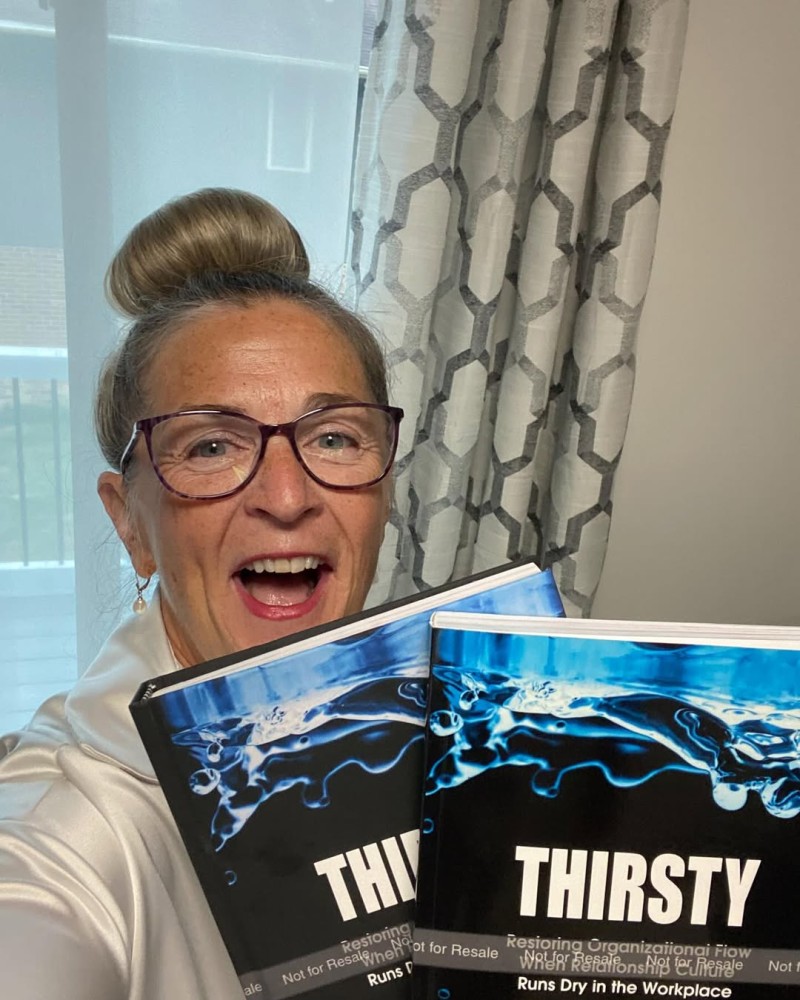
Those action-takers? They're reporting something that caught me a little off guard.
The enthusiasm is immediate and genuine.
I expected people would take their time.
Instead, I'm getting messages like this one from an HR expert: "My copy has been ordered. I am looking forward to the knowledge."
Simple words, but they carry the weight of anticipation.
These aren't casual purchases. They're investments in transformation.
Leaders aren't just buying a book. They're committing to change.
When people feel ready to receive new insights and apply them to their workplace challenges, they respond in ways that remind you why this work matters.
Not with grand declarations or dramatic commitments.
But with genuine excitement about what's possible.
What becomes possible when you stop managing a dehydrated culture and start restoring it?
Because here's what I've learned in over 35 years of this work.
Cultural transformation doesn't happen in boardrooms or strategic planning sessions.
It happens in the moment when a leader decides to address what everyone sees, but no one discusses.
I've been watching this same dynamic for decades, dare I say technically five decades. In the nineties it was empowerment with boundaries.
"If we empower our employees, all shall be fixed." That's almost comical now.
Then came the 2000s with digital transformation, then DEI, then AI.
Different pieces, same pattern. Different language, same drought.
The leaders who break the pattern aren't the ones with the best strategy.
They're the ones who stop managing the drought and start restoring the water source.
As you read this, your team isn't waiting for you to become a different person.
They're waiting for you to acknowledge what they already know.
That something needs to change, and you're willing to figure it out together.
They don't need you to be perfect. They need you to be present.
And maybe, just maybe, brave enough to ask, "What do you need from me?"
I've seen this in every organization I've walked into. I can literally feel it, the energy when a leader finally names what everyone has been thinking.
The relief. The shoulders dropping.
The moment when "we can't talk about this" becomes "thank God someone finally said it."
That moment doesn't require a comprehensive transformation plan.
It requires one leader willing to say: "I see what's happening, I don't have all the answers, and I want us to figure this out together."
That's it. That's the first drop that starts the river flowing again.
I want to be honest about something: the path from knowing to doing isn't clean.
It doesn't follow a neat timeline.
Things get messy before they get better. People push back. Old patterns resurface.
There are days when you wonder if any of it is working.
That messiness isn't a sign you're doing it wrong. It's how healing works.
I've been in the boat, I've been in the storm, I've made it back to shore, and I've got stories to tell.
And the one thing every storm has taught me is that the leaders who stay in the boat, imperfectly, uncertainly, with white knuckles if necessary, are the ones whose cultures actually transform.
The ones who wait for calm seas never leave the harbor.
You don't have to transform your entire culture overnight.
You don't have to be the perfect leader who has all the answers.
You just have to care enough to start.
Tomorrow morning, you could ask one person on your team.
"What's one thing I could do differently that would make your experience here better?"
And then listen. Not to respond. Not to defend. Just to listen.
That's not a grand gesture. It's a deposit. And deposits compound.
The frameworks exist.
The path is documented in Thirsty.
The complete frameworks. The step-by-step guides.
The troubleshooting for when things get messy. And they will get messy.
That's how healing works.
The leader your people need is the one who starts today.
Even if, especially if, they don't feel ready yet.
The framework works through a progressive 9-step journey from cultural dehydration to sustained health. It begins with detection, sensing early warning signs traditional metrics miss, then moves through trust restoration, belonging activation, communication flow development, emotional intelligence building, and daily culture-tending practices. Each step builds on the previous one, creating compounding momentum. The framework treats culture as a living system, not a project to complete.
The Flow-State Culture Framework was developed by Shelley Smith, founder and CEO of Premier Rapport, based on over 35 years working inside organizations across hospitality, manufacturing, defense, maritime logistics, family businesses, and Fortune 500 companies. The framework emerged from pattern recognition across decades of transformation work and is documented in Thirsty: Restoring Organizational Flow When Relationship-Culture Runs Dry in the Workplace.
The 9 steps progress from diagnosis to sustainable practice: (1) The Dehydration Diagnostic, (2) The Dashboard Blindness Audit, (3) The Belonging Signal Assessment, (4) The First Drop Protocol, (5) Three Trust Currents, (6) Communication Current Assessment, (7) The Relationship Preservation System, (8) The EQ Pipeline, and (9) The Daily Gardener's Choice. Each step addresses a specific dimension of cultural health while building toward self-sustaining organizational flow.
Observable shifts can begin within weeks when leaders commit to consistent action. Meaningful transformation, where new patterns become self-sustaining, typically takes 6 to 18 months depending on dehydration depth and organization size. The most important insight is that transformation never truly "ends." Sustainable cultures require ongoing daily attention, which is why the framework's final step focuses on treating culture as a living system needing continuous tending.
Explore articles, case studies, and resources - crafted to keep you ahead.