
Your inclusion metrics look perfect, but 51% of star performers are quietly job hunting. Learn the 3 belonging signals that separate companies retaining top talent from those losing them.

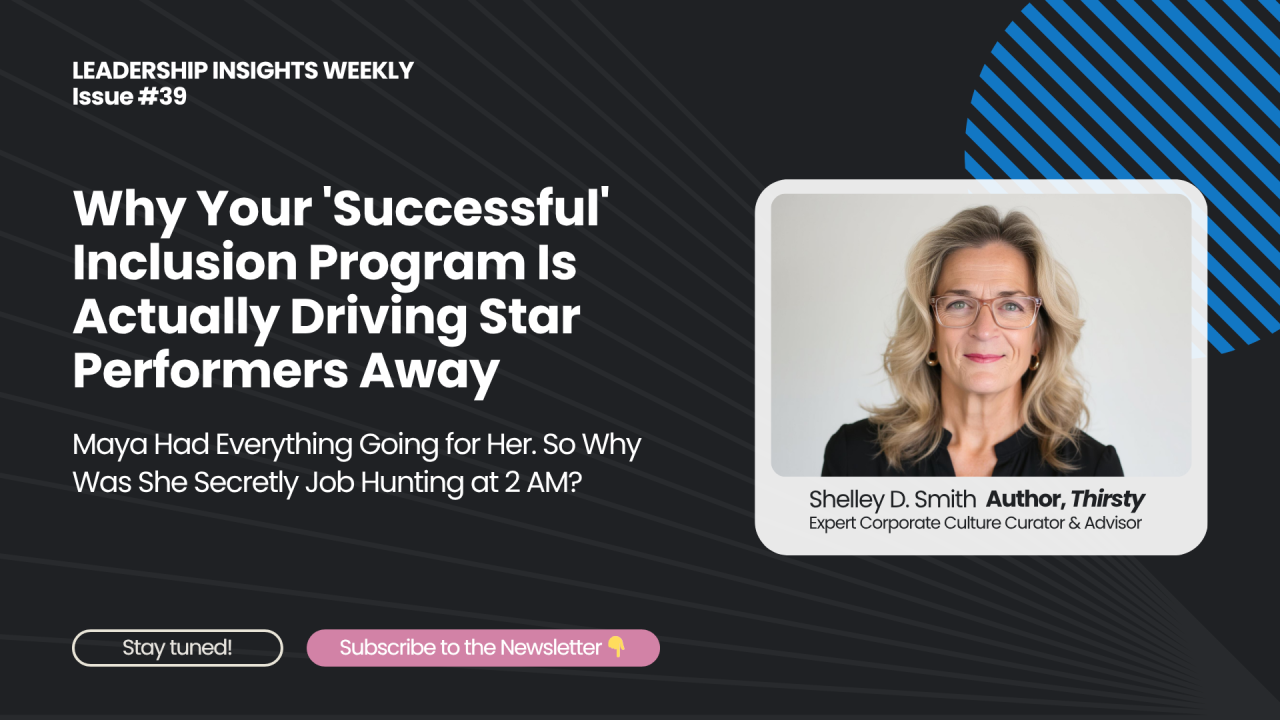
Stellar reviews, executive respect, and a 23% cost-saving breakthrough that could reshape the entire operation.
VP title. Game-changing idea. Perfect execution.
She presents to the quarterly planning meeting.
Clear data. Solid reasoning. Revolutionary potential.
The room goes dead quiet.
Not "thinking quiet." Please-move-on quiet.
She watches colleagues study their papers, avoiding eye contact.
The 4.7-second silence stretches like an eternity.
"Interesting perspective. Let's... circle back."
Her breakthrough dies.
That night, she finds herself staring at her laptop screen at 2 AM, cursor hovering over the "Update Resume" button.
"Does my contribution actually matter here, or am I just filling a quota?"
Six months later, everything changed. Same person. Same caliber insight.
She opens her mouth. The room leans in.
"This connects perfectly to operational efficiency.
How do we implement this?"
CEO taking notes. Three people building on her framework.
Eighteen minutes later, she's leading a cross-functional team.
What shifted?
The invisible signal system that separates companies retaining stars from those losing them.
She wasn't excluded from that first meeting. She was invited, spoke, was heard.
But she wasn't valued.
Inclusion says: "You're welcome at our table."
Belonging says: "Your voice shapes what happens at our table."
That distinction is quietly costing organizations billions. $223 billion in cultural turnover over the past five years, while 51% of star performers are secretly job hunting despite record-high inclusion scores.
Companies that crack the belonging code see 89% higher retention and 3.2x more innovation.
The ones that don't?
They keep celebrating inclusion metrics while their best people update resumes at 2 AM.
I've watched this pattern play out in conference rooms for three decades.
The pattern I first noticed working in hospitality, where the values on the wall didn't match the reality on the floor, is the same dynamic.
Just dressed up in different language.
This is part of the broader pattern of cultural dehydration that silently kills organizational potential.
The surface looks healthy. The dashboards say green.
But underneath, the disconnection is already spreading.

Belonging isn't a feeling you create. It's a signal system you activate.
The silent question your people are asking: "Can I disagree without career suicide?"
This is the internal monologue running through your people's minds before they speak up.
They're calculating risk versus reward, weighing whether their insight is worth potential retaliation. When people stay quiet in meetings, they're not being agreeable.
They're being protective.
I've felt this dynamic within minutes of walking into organizations.
The email exchanges ahead of time tell me a lot.
The words, the body language, who's talking and who's not talking. It tells you whether the safety current is flowing or frozen.
Your micro-practice: When someone raises a concern, try...
"Thanks for catching that. Walk me through your thinking. What did you notice that I might have missed?"
The silent question: "Do my unique contributions actually shape outcomes?"
Your people are wondering whether they're interchangeable parts in a machine.
They watch generic task assignments get distributed without consideration for their unique strengths.
When people disengage, they're not being lazy. They're protecting their sense of worth.
This is the pattern I call "feeling seen, valued, and heard." It isn't a slogan. It's the diagnostic I use in every engagement.
When people don't feel it, they leave, regardless of what the inclusion metrics say.
Your micro-practice: Before assigning tasks, ask "How does this connect to your strengths?" Then actually let the answer shape the assignment.
The silent question: "Do I see myself growing here long-term?"
Your high performers are mentally time-traveling, trying to envision themselves in your organization two years from now.
When they can't see a path forward that excites them, the 2 AM resume updates begin. When people stop contributing at their highest level, they're not losing motivation.
They're redirecting it toward opportunities that offer growth.
Your micro-practice: Ask one person weekly about their growth aspirations.
Connect their goals to upcoming opportunities, not next quarter's tasks, but next year's vision.
This isn't about being "nice." It's about being strategic with human potential.
Engineering teams with strong belonging signals ship products significantly faster because psychological safety accelerates problem-solving.
Manufacturing operations with belonging cultures see dramatically fewer safety incidents because people speak up about risks instead of staying quiet.
When people feel essential, they bring their best thinking to complex problems.
When they feel replaceable, they do the minimum required.
Belonging doesn't exist in a vacuum. It flows through the communication currents that shape your culture.
When communication operates as a one-way flood or stagnant pool, belonging signals get drowned or trapped.
When communication flows as a living current, where meaning circulates freely and ideas cross-pollinate, belonging signals strengthen naturally.
You can't build belonging in a culture where people can't even get their words heard.
Week 1: Which of the three signals, safety, value, or future, is weakest on your team? Try one new practice and notice not just behavior changes, but emotional shifts in team dynamics.
Week 2: Amplify your strongest signal. Build it into three regular touchpoints where people feel most vulnerable.
Week 3: Integrate all three signals. Track leading indicators: meeting participation shifts, unsolicited idea submissions, and internal referral rates.
The question that should keep every leader up at night isn't "Are our inclusion metrics strong?"
It's this: can your star performers disagree with you without career consequences?
The honest answer tells you whether you've built inclusion or belonging. Only one of them keeps your best people.
Inclusion means people are invited, represented, and given access: "you're welcome at our table." Belonging means people's contributions actively influence decisions and outcomes: "your voice shapes what happens at our table." Many organizations achieve strong inclusion metrics while failing at belonging, which is why star performers leave despite feeling "included."
Diverse employees often leave because inclusion addresses representation without creating genuine belonging. When someone presents a breakthrough idea and the room responds with silence rather than engagement, they experience the gap firsthand. The critical missing element is whether contributions actually influence outcomes, not just whether people have a seat at the table.
Belonging is measured through three signal currents rather than traditional survey metrics: the Safety Current (people challenge ideas without fear), the Value Current (unique contributions shape actual outcomes), and the Future Current (people see themselves growing long-term). Leading indicators include meeting participation shifts, unsolicited idea submissions, and internal referral increases.
Belonging signals are observable patterns indicating whether people feel genuinely valued versus merely included. The three core signals are psychological safety (open disagreement without career risk), value recognition (unique strengths shape real outcomes), and future integration (growth conversations focus on expanding impact). When present, organizations see dramatically higher innovation and retention rates.
Explore articles, case studies, and resources - crafted to keep you ahead.