
Trust doesn't break suddenly, it dehydrates over months. Learn the 5-step framework for rebuilding organizational trust after leadership failure, and why prevention matters more than recovery.

I've watched CEOs make two critical mistakes after a public failure.
The first? They think an apology is enough.
The second? They believe time heals all wounds.
Both are wrong.
We're living through an era of high-profile CEO scandals that seem to break weekly.
From tech giants to traditional corporations, leaders are falling from grace at an unprecedented pace.
And in almost every case, the response follows the same predictable pattern: a carefully crafted apology, a brief media silence, then a hope that the news cycle will move on.
But here's what these leaders don't understand.
Their employees aren't just waiting for the next headline.
They're watching, wondering if their leader has any idea how to actually rebuild what's been broken.
The question isn't "How do I make this go away?"
It's "How do I restore the trust that keeps my organization functioning?"
That question matters because it reveals a fundamental misunderstanding about how trust actually works in organizational culture.
An apology isn't a destination. It's barely the starting line.
Here's what I've learned after years of studying cultural dehydration: trust doesn't break suddenly, and it doesn't rebuild with a single gesture.
It's more like watching a relationship slowly dehydrate.
What looks like a sudden crisis is usually the final symptom of something that's been drying up for months or years.
But let me be clear about something.
Not every breach of trust can be repaired.
Some mistakes are so catastrophic, so fundamentally damaging to the core integrity of leadership, that recovery becomes impossible.
When leaders cross certain ethical lines (fraud, abuse, or actions that jeopardize the operational ability of their companies) the damage extends beyond personal reputation to organizational survival.
This is why prevention matters more than recovery.
As a leader, your primary responsibility isn't learning how to rebuild trust after you've shattered it.
It's ensuring you never put your organization in a position where its very existence depends on your ability to recover from a scandal.
That said, for leaders facing recoverable situations (errors in judgment, communication failures, or cultural missteps that haven't crossed into existential threats) here's the hope:
If you understand the actual mechanics of trust rebuilding, recovery isn't just possible.
It's predictable.
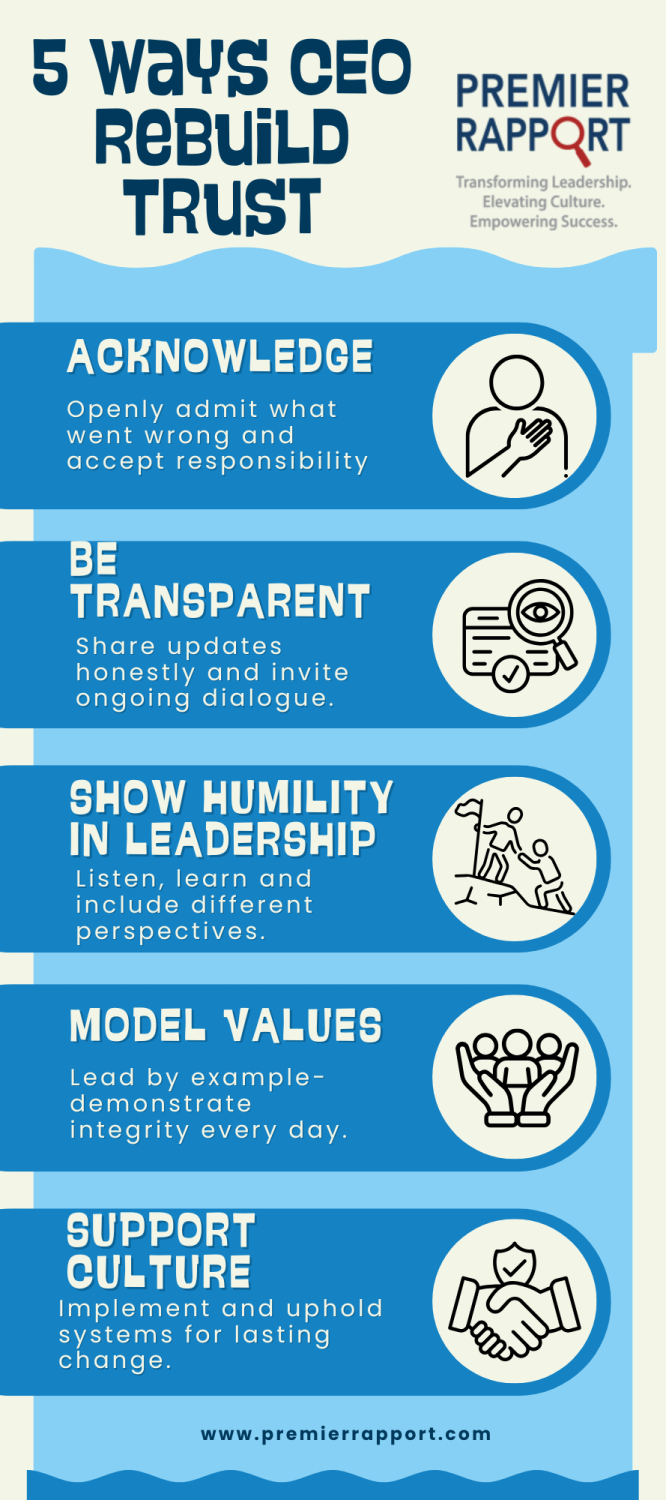
This isn't about crafting the perfect PR statement. It's about breaking the silence that's been suffocating your organization.
Start with an immediate, sincere apology that openly acknowledges your error and its impact.
But here's the crucial part most leaders miss: clearly outline your personal responsibility without minimization or blame-shifting.
Your team has been watching the spin, waiting for someone to just tell the truth.
Then explain the root of what happened and the specific steps you're taking to prevent recurrence. Not vague promises. Concrete actions with timelines.
Once you've broken the silence, you can't go quiet again.
Communicate openly and frequently about ongoing developments, both positive and negative.
This is where most leaders fail.
They share the good news and hide the setbacks.
Offer regular updates through multiple channels: team meetings, written messages, and Q&A sessions where people can ask the hard questions.
But don't just talk at your people.
Create structured mechanisms for feedback through surveys, suggestion boxes, or direct forums.
When a CEO becomes visible, honest, and communicative, employees stop filling gaps with rumors and skepticism.
This accelerates cultural repair faster than any other single action.
This is where the real work begins.
Invite input from all employee groups and affected parties.
Make space for dialogue about the event and its cultural ramifications, even when those conversations are uncomfortable.
Publicly commit to learning about and valuing diverse perspectives across your organization.
If needed, engage professional facilitators to run cultural reconciliation or listening sessions.
A culturally rehydrated leader practices humility, actively closes gaps in understanding, and is willing to adapt based on employee feedback.
This proves that respect and learning are continuous processes, not one-time events.
Here's the test that separates real recovery from performative gestures.
Recommit to your core company values by weaving them into every leadership decision you make.
Demonstrate reliability through the small things. Keep promises, meet deadlines, and deliver on public commitments.
But go further: recognize and reward behaviors throughout the organization that reflect the desired culture.
Values are fortified not by policies hanging on walls, but by consistent demonstration at every leadership level.
Your employees are watching for daily proof, not statements.
Finally, establish or revisit systems for accountability.
Clear codes of conduct, transparent reporting structures, and impartial enforcement that applies to everyone, especially leadership.
Support leadership development for yourself and your executive team, reinforcing ethical maturity and multicultural awareness.
But here's the crucial element: ensure that new initiatives for cultural repair persist beyond the immediate crisis. Measure progress and adapt as needed.
Rebuilding trust isn't an event. It's ongoing.
Institutionalizing change turns promise into progress and ensures that lessons are genuinely absorbed into company DNA.
The recent wave of CEO scandals has shown us something important.
Repairing trust after a high-profile leadership failure demands far more than an apology.
It requires a clear, consistent commitment to transparency, cultural responsiveness, and daily demonstration of values, starting with you but cascading through the entire organization.
But remember this crucial distinction.
These strategies work for recoverable situations.
The most important lesson isn't how to rebuild trust after you've broken it.
It's how to lead with such integrity that you never put your organization's survival at risk in the first place.
Your workplace culture isn't broken. It's just dehydrated.
And with the right approach and unwavering ethical foundation, you can restore the flow of trust and engagement that makes great organizations thrive.
Five sequential steps: take sincere ownership without minimization, activate transparent and consistent communication (both good and bad news), demonstrate cultural humility through listening sessions and genuine dialogue, model values through daily actions rather than statements, and institutionalize accountability systems that apply to everyone, especially leadership. The timeline requires sustained effort, not a single gesture.
No. Some mistakes are so catastrophic (fraud, abuse, actions jeopardizing organizational survival) that recovery becomes impossible. The distinction matters: errors in judgment, communication failures, and cultural missteps that haven't crossed ethical lines are recoverable when leaders understand trust mechanics. Prevention through integrity always matters more than recovery after failure.
An apology is barely the starting line, not the destination. Trust doesn't break suddenly and doesn't rebuild with a single gesture. What looks like a sudden crisis is usually the final symptom of something drying up for months or years. Recovery requires sustained transparency, daily demonstration of values, and institutionalized accountability, not just words.
Initial shifts appear within weeks when leaders activate transparency and consistent communication. Meaningful cultural restoration typically takes 6 to 18 months of sustained effort. The key accelerator is visible, honest communication: when employees stop filling gaps with rumors and skepticism, repair accelerates faster than any other single action.
Explore articles, case studies, and resources - crafted to keep you ahead.