
Gallup's data from 88 million employees shows engagement at a decade low. But surveys measure where culture was, not where it's going. Here are 5 leading indicators that warn you 6 to 12 months earlier.

Gallup just released data from 88 million employees.
Only 30% are engaged. The lowest in a decade.
And every leadership outlet is running the same headline: managers are the problem.
I want to offer you a different lens. Not because manager behavior doesn't matter. It does.
But because the way we're interpreting this data is leading leaders to ask the wrong question.
Most people are asking, "How do we fix engagement?"
The question that actually changes outcomes is this.
What were we not seeing 9 to 12 months ago, when this breakdown was still preventable?
Engagement scores are lagging indicators. They measure where your culture was, not where it's going.
By the time disengagement shows up in an annual survey, the erosion has already been visible in daily behavior for months.
You don't have an engagement crisis. You have a detection problem.

This is the distinction that changes everything.
Confirmatory data tells you the problem landed. Diagnostic data tells you where it started.
Your annual engagement survey is confirmatory.
It confirms what your culture already experienced months ago. It is not, and was never designed to be, an early warning system.
This is what I call Dashboard Blindness. When leaders become so anchored to their metrics that they stop reading the room.
The dashboard says green, so they assume things are fine. Meanwhile, the culture is quietly drying up.
The 88 million employee dataset is valuable. But only if it prompts you to ask better questions about what you're measuring, and when.
Here is the hard truth. If engagement scores are the primary signal you're watching, you are managing the past.
And your best people, the ones with options, are already making decisions about their future while your dashboard still reads neutral.
In my work with leaders and organizations, I use a framework I call Cultural Dehydration.
It's the slow, often invisible erosion of trust, psychological safety, and relational connection that happens long before it ever surfaces in a metric.
Dehydration doesn't start with a crisis. It starts in micro-moments that nobody is officially tracking.
It sounds like, "let's take that offline," when the offline conversation never actually happens.
It looks like the same three people talking in every meeting while everyone else goes quiet.
It feels like a slow shift from "we decided" to "they decided" in how your team refers to leadership.
None of these moments show up on an engagement dashboard. But every one of them is a leading indicator.
A signal that trust is evaporating 6 to 12 months before it becomes a number you can measure.
Fortune's analysis points to psychological safety as the core driver. That's accurate. But here's what gets missed.
Psychological safety doesn't collapse overnight. It evaporates in micro-moments, daily, quietly.
And when we jump to "blame the manager," we skip the more important question. What systems, structures, and patterns made it difficult for managers to create safety in the first place?
Something I see constantly.
Organizations invest heavily in training managers on psychological safety while maintaining meeting structures, decision processes, and workload expectations that actively prevent them from creating it.
You cannot train your way out of a structural problem.
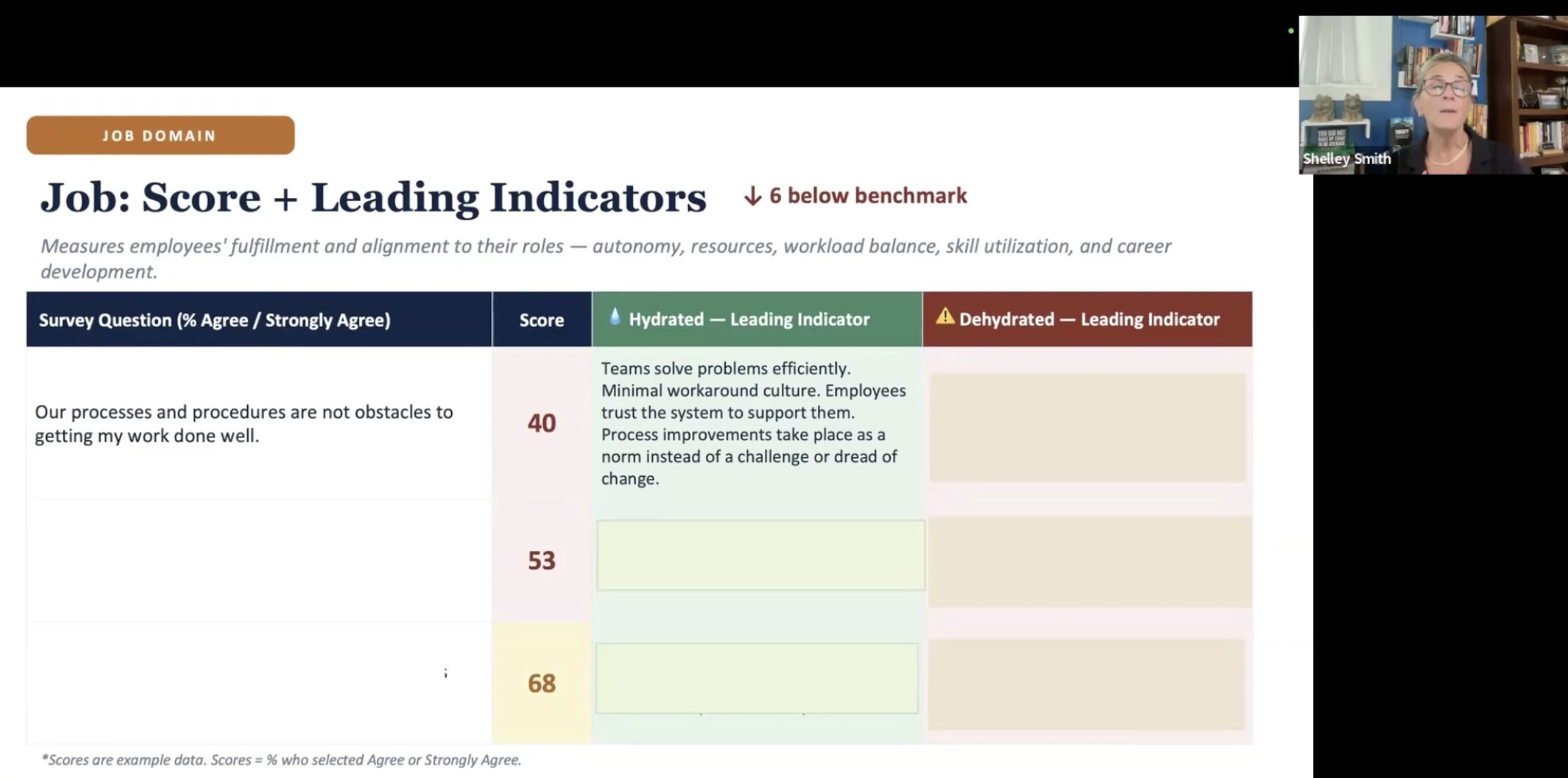
These are the signals that give you a 6 to 12 month window to restore the flow before disengagement becomes a full-blown crisis.
They're observable. They're happening right now in your organization. Most leaders just aren't looking for them.
Pay close attention to the pronouns your team uses when they talk about leadership decisions.
When "we decided" becomes "they decided," psychological safety is evaporating.
This linguistic shift is one of the earliest and most reliable predictors of disengagement. It signals that people have moved from "part of the team" to "subject to the team."
Notice which meetings go flat.
Where does energy drop? Who stopped contributing ideas, and when? Which rooms feel forced versus genuinely collaborative?
The silence in a room where people used to talk freely is data. It's telling you something your survey cannot.
Track which questions trigger defensiveness or shutdown in your meetings.
When people stop asking, "why are we doing this?" they haven't bought in. They've given up on being heard.
Compliance looks identical to buy-in on the outside. Inside, it's the first stage of departure.
Are people asking fewer questions than they were six months ago?
Declining question rates are one of the most consistent early warning signs I observe.
When curiosity goes quiet, it's because people no longer feel safe enough to be curious. That gap doesn't close on its own.
Are your people taking real time off, or working vacations where they never actually disconnect?
Sustainable recovery predicts sustained engagement. Performative rest predicts burnout. And burnout won't show in your metrics for months after it's already cost you your best people.
The difference isn't intelligence. It isn't resources. It's what leaders decide to measure, and how often they actually look.
Leaders who show up differently in the next Gallup report aren't reacting fastest to this headline. They're already asking what their current data isn't showing them.
They stop treating engagement scores as diagnostic. They use them as confirmation, then ask where the problem actually started.
They track leading indicators alongside lagging ones. They identify their most perceptive people, not most senior, most observant, and ask what patterns are showing up that the metrics aren't catching.
They audit systems before they train people. Before investing in manager training on psychological safety, they ask whether their meeting structure actually allows managers to create it. Whether their processes reward collaborative problem-solving, or just fast compliance.
They notice linguistic shifts, energy patterns, and silence signals in real time. This gives them 6 to 12 months of lead time. The difference between straightforward restoration and full crisis management.
They treat culture as a living system, not a completed project. Every day you don't tend it, it weakens.
The most expensive cultural intervention is always the one you waited too long to make.
Here's a simple diagnostic you can run right now. No survey. No consultant required.
In your next team meeting, pay attention to these three things.
Who speaks up, and who goes quiet? Don't fix it yet. Just notice.
When a decision gets announced, does the team say "we" or "they" when referring to leadership? Listen for it.
When someone starts to ask a hard question, do they finish it? Or do they stop mid-sentence and redirect?
The silence around certain questions tells you everything about your culture's hydration level.
If what you observe makes you uncomfortable, that discomfort is data. Don't dismiss it.
It's one of the earliest signals you have.
The Gallup data from 88 million employees is real. It matters.
But it's telling you about decisions made 9 to 12 months ago, not about what's happening in your organization today.
Blaming managers is convenient. Fixing the systems around them is the work.
And the leaders who actually move the needle aren't the ones who respond fastest to this report. They're the ones who already knew something was off, because they were watching the right signals.
The question to carry into this week isn't, "how do we fix engagement?"
It's this. What are we not seeing right now, while we still have time to do something about it?
This is the work at the heart of my book, Thirsty, and the Flow-State Culture Framework I teach inside it. Detection before crisis. Tending before drought.
If this resonated, and you're sensing that the picture your current metrics paint doesn't match what you're feeling in the room, that gap is exactly where the work begins.
I work with CEOs and leadership teams to install the detection systems that surface culture problems 6 to 12 months earlier, while restoration is still straightforward.
Book a Flow-State Culture discovery call and let's look at what your dashboard isn't showing you.
Shelley D. Smith, the culture curator behind Premier Rapport, is its CEO and the author of Thirsty. A Certified Predictive Index Partner, executive coach, and speaker, she has spent 35+ years across hospitality, franchise operations, and organizational leadership helping companies detect and repair culture before it shows up in the numbers.
Learn more at premierrapport.com/about or start a conversation at premierrapport.com/contact.
Gallup, State of the Global Workplace report referencing data from 88 million employees, 2026.
Fortune, analysis of Gallup engagement data and psychological safety drivers, 2026.
Why do engagement surveys miss culture problems?
Engagement surveys are confirmatory, not diagnostic. They confirm what your culture already experienced 9 to 12 months ago. By the time disengagement shows up in an annual survey, the erosion has been visible in daily behavior for months. Surveys were never designed as an early warning system.
What are leading indicators of workplace culture?
Leading indicators are observable signals that surface 6 to 12 months before disengagement becomes measurable. The five most reliable are: linguistic shifts from "we" to "they," energy patterns in meetings, silence signals around hard questions, declining question frequency, and recovery patterns including whether people genuinely disconnect during time off.
What does it mean when employees say "they" instead of "we"?
The pronoun shift from "we" to "they" signals that psychological safety is evaporating. People have moved from feeling part of the team to feeling subject to the team. This linguistic change is one of the earliest and most reliable predictors of disengagement and turnover, often appearing 6 to 12 months before metrics catch up.
What is cultural dehydration?
Cultural dehydration is the slow, often invisible erosion of trust, psychological safety, and relational connection inside an organization. It happens long before it surfaces in any metric. It starts in micro-moments, daily and quietly, and signals are visible 6 to 12 months before they become a number leaders can measure.
How do you measure culture health beyond engagement surveys?
Track leading indicators alongside lagging ones. Audit meeting structures and decision processes before training managers. Identify your most observant people and ask what patterns they see that the metrics miss. Watch for linguistic shifts, energy patterns, and silence signals in real time. That practice gives you a 6 to 12 month restoration window before crisis.
Explore articles, case studies, and resources - crafted to keep you ahead.