
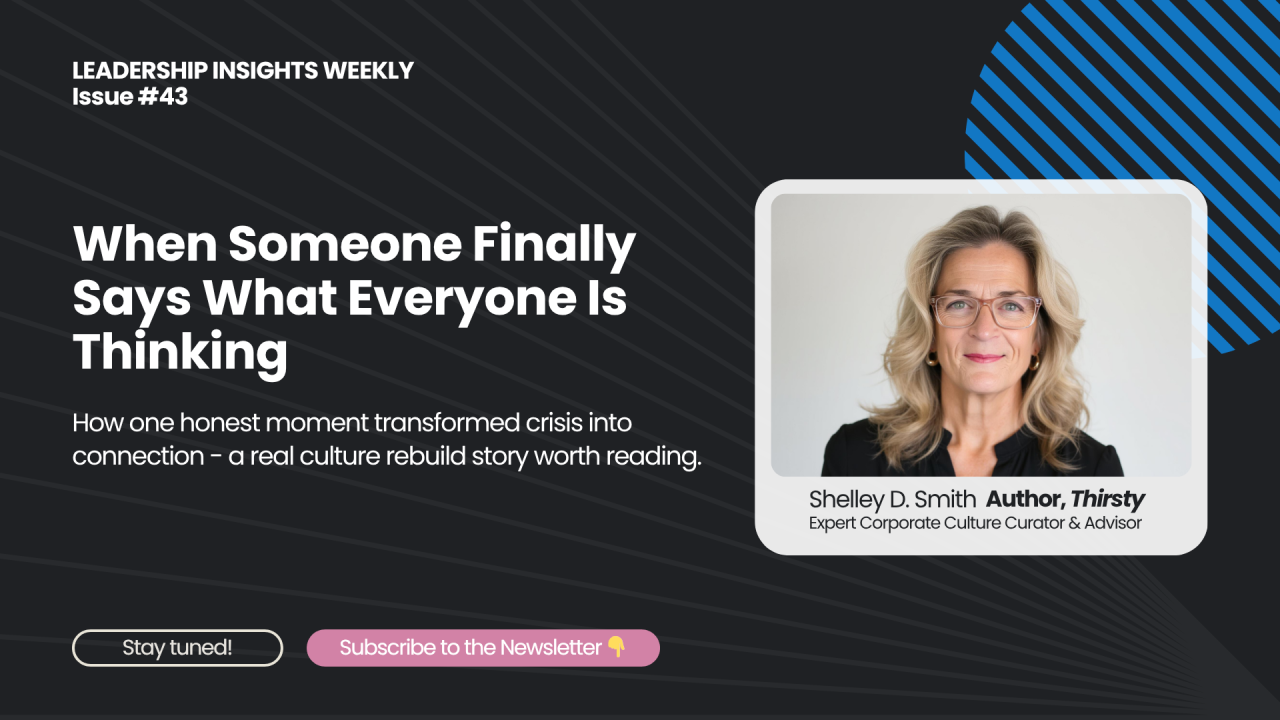
Cultural breakdown isn't the problem. It's often the permission to finally change. Learn the 4-word question that transforms toxic team dynamics and rebuilds trust.

Jon Mayo had just done something that would terrify most consultants.
He'd stopped a toxic meeting mid-sentence and asked the bullies to leave.
"If I need to fly back tonight, we can terminate this now," he told the remaining shell-shocked leaders. "However, this is what I'm observing and I personally will not continue to tolerate it."
What happened next proves a key principle.
Sometimes the most powerful transformations begin when someone finally says what everyone else is thinking.

When Jon cleared that room, he forced what every broken culture eventually faces.
The moment when reality can no longer be disguised by corporate politeness.
Here's what I've learned from facilitating dozens of these transformations.
Cultural breakdown isn't the problem. It's often the permission to finally change.
Organizations trapped in what I call cultural dehydration, where morale crashes and enthusiasm evaporates, must move through acknowledgment before any real healing can begin.
You can't restore what you won't admit is broken.
Jon's intervention wasn't luck.
His approach of examining underlying systems rather than just surface behavior has proven effective across multiple organizations.
When leaders claim they have priorities, but see no progress, Jon applies the same diagnostic:
"Show me your calendar. If I don't see time prioritized for that team to focus on continuing to move the needle forward, then I can simply say it's not your priority because your actions are not substantiating what the priority is."
A completely separate case: Jon worked with a different company hemorrhaging $1.2 million annually.
Not just from turnover.
From the compound effect of broken trust.
Systems failures, process breakdowns, and innovation drought.
Both situations follow the same pattern. I call it the ACC Framework.
Analyze the real situation (not just symptoms).
Curate alignment and targeted processes.
Create the changes that stick.
Jon's insight captures why cultural problems become financial catastrophes.
"Any element out of integration is a crack in the vessel that causes dehydration."
Back at the company with the confrontational meeting, the transformation didn't happen through complex methodologies or elaborate team-building exercises.
It started with one question Jon taught them to ask.
"How can I lead better?"
This simple shift, from blame to responsibility, from defending to improving, mirrors the leadership evolution I've documented across every successful cultural turnaround.
Leaders stopped trying to preserve methods that weren't working.
They started asking how to honor principles while adapting to new realities.
Everything changed.
As Jon observed...
"The moment you have that realization and give yourself the gift of awareness, you can begin to create solutions. But don't look for quick fixes. Ask where you're creating what you don't want."
At that same company, the one where Jon had stopped the toxic meeting, he witnessed something remarkable in the weeks that followed.
Questions that once triggered defensive explosions became collaborative problem-solving opportunities.
The behavior that had made meetings unbearable simply stopped.
Leaders began focusing on solutions instead of defending positions.
People actually started looking forward to meetings again.
This wasn't just behavioral change.
This was moving from the Sandstorm Syndrome (increased conflict) to the Flowing River Syndrome (natural, effortless collaboration).
Jon's key insight: "Trust is a lubricant that allows for more efficient and effective movement because people are more willing to try things that are uncomfortable when there's a foundation of goodwill."
That foundation of goodwill is what trust restoration is designed to build. Not as a one-time intervention, but as a self-reinforcing cycle.
Here's how to recognize where your culture stands.
Questions are met with silence or deflection.
Accusations and defensiveness dominate discussions.
People spend more energy protecting themselves than solving problems.
Information flows freely across departments.
Conflicts become collaborative problem-solving sessions.
Energy focuses on solutions, not blame.
The diagnostic that reveals the truth: look at how different groups actually behave under pressure, not what they say in comfortable moments.
Jon's story proves that every thriving culture was once trapped in dysfunction.
The difference?
Someone was willing to face the truth and take the first step toward healing.
Cultural transformation requires what Jon demonstrated: the courage to stop the meeting, clear the room, and have the conversation everyone's been avoiding.
The question isn't whether your culture needs help.
It's whether you're ready to start asking, "How can I lead better?"
Rebuilding starts with acknowledgment: you can't restore what you won't admit is broken. The most effective approach follows three phases: analyze the real situation by examining underlying systems and communication patterns, curate alignment through conversations shifting from blame to responsibility, and create sustainable changes by embedding new behaviors into daily operations. The turning point often comes from one question: "How can I lead better?"
Trust restoration requires someone willing to name what everyone sees but nobody discusses, the truth-telling moment that breaks avoidance cycles. Then examine underlying systems rather than surface behaviors, shift team language from blame to shared responsibility, and build new patterns where questions trigger collaboration instead of defensiveness. Meaningful shifts often begin within weeks of the initial truth-telling moment.
Observable behavioral shifts can begin within weeks when the approach is systematic. The initial breakthrough often happens quickly once someone names dysfunction openly. Sustained trust requires ongoing daily deposits. Organizations treating trust restoration as continuous practice see lasting results within 3 to 6 months.
Yes. Every thriving culture was once trapped in dysfunction. Cultural breakdown often becomes the permission to change. The repair process moves from increased conflict (questions trigger defensiveness) to natural collaboration (information flows freely). The critical first step is acknowledging that the culture is dehydrated, not broken beyond repair, but in need of intentional restoration.
Explore articles, case studies, and resources - crafted to keep you ahead.